Every Christmas, I find myself asking the same question: Am I buying something my children will actually play with, or am I purchasing another expensive object destined to disappear underneath the couch by January 3?
Because, as the mother of five children ranging from two to ten years old, I can tell you the price tag has absolutely no bearing on how entertaining my kids will find something. Sometimes the expensive toy is a hit. Sometimes the cardboard box it arrived in is the real Christmas miracle.
And sometimes I spend twenty minutes putting something together only to find the kids are much more interested in the packaging. LOLOL. Welcome to motherhood.
This year I wanted to look beyond the latest holiday toy trends and ask a better question: what makes a gift worth buying after the wrapping paper is gone?
Enter Jen Wirt, founder and CEO of Coral Care, a pediatric therapy platform whose 2026 Holiday Gift Guide features 100 gift ideas organized by age and developmental areas including movement, language, fine motor skills, sensory needs, and social-emotional development.
Coral Care connected me with Jen for a written interview. And naturally, I had questions. Nine of them, actually. Because if you’re offering to help me shop for five children living in the same house, I have follow-ups. 🤣
We’ve also worked with Coral Care on an earlier Halloween family feature, so I was excited to dig into their holiday recommendations.
In the Interview Room: Jen Wirt of Coral Care

Meet Jen Wirt
Jen founded Coral Care after her infant daughter showed signs of developmental delays and she discovered how difficult it could be to find timely, in-network pediatric therapy. She wanted to make it easier for other families to get the support they need. Today, Coral Care connects families with speech, occupational, and physical therapists who provide in-home care, while helping clinicians build sustainable practices.
Before founding Coral Care, Jen worked in engineering, product management, and digital health, including roles with Bose, Samsung, and WeightWatchers. She holds engineering degrees from the University of Rochester and Brown University, plus an MBA from Babson College. She’s also a mom of two, which makes our conversation about choosing toys that actually support children’s development especially fitting. Biography supplied by Jen’s public relations team.
The nine written questions and answers below are preserved from the responses provided by Jen Wirt through Pitch PR. Editorial introductions are my own.
1. What makes a toy genuinely useful for a child’s development, and which “educational” claims should parents question?
One of my first questions was about those toys that promise to do absolutely everything. Do kids actually benefit from all the lights and buttons, or are we simply buying ourselves another noisy soundtrack? Because I’ve got enough of those already. LOL.
A useful toy makes the child do the work. Our therapists keep coming back to the same few signs:
• The child does more than the toy. A wooden ring stacker or a set of blocks only does something when your child acts on it. A toy that lights up, talks, and sings on its own mostly teaches a child to press a button and
watch.
• It can be played with in more than one way. Open-ended toys like blocks, play silks, and play dough work for pretend play, building, and talking all at once.
• It invites a grown-up in. As Khaki Brown, Coral Care SLP, puts it: “Some of the richest language I hear happens with a basic toy or book, an engaged grown-up, and no rush.”
• It’s a little bit hard. The best toys sit just past what a child can already do.
Claims to be skeptical of:
• “Makes your baby smarter” or “boosts IQ”
• Screen-based “learning” for infants and toddlers
• Toys that “teach” letters and numbers through repeated button presses
• “Developmentally proven” with no detail about who tested it or how
2. How should parents balance age recommendations with a child’s individual interests and abilities?
With five kids at very different stages, the ages on the boxes are a serious consideration in our house. Here’s how Jen distinguishes a suggestion from a safety rule.
There are two kinds of age labels, and they deserve different treatment:
• Safety labels (like “not for children under 3”) are firm. They usually mean small parts or choking risk, and that holds no matter how advanced a child is.
• Developmental age ranges are a starting point. Children develop unevenly. A 4-year-old might be ahead in language and still building fine motor skills.
We organized our guide by age, then tagged every pick by skill area: fine motor, gross motor,
speech and language, sensory and regulation, social-emotional, and thinking and problem-solving. Parents can start with their child’s age, then look one section up or down for something that fits what their child loves or is working on. A child who’s crazy
about trains will put up with a harder challenge if it involves trains.
3. What features help a toy grow with a child and hold their interest beyond the holiday excitement?
This is my Christmas shopping nightmare: a toy that’s the greatest thing ever on December 25 and completely abandoned by January 3. What should we look for instead?
Look for toys that change as your child changes:
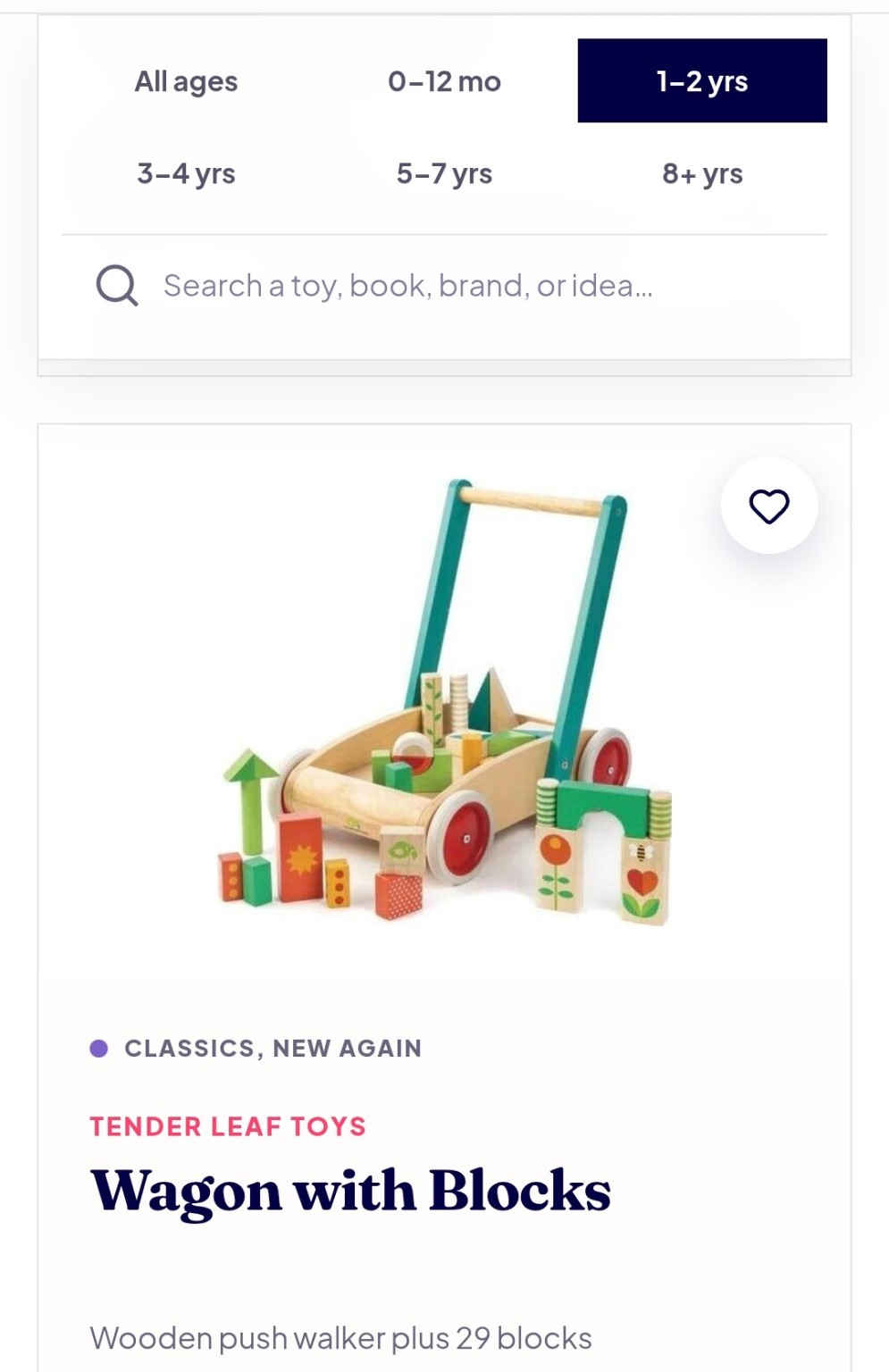
• Several stages of use. The Prop-A-Pillar supports tummy time, then stretches out for crawling, then curves to help with sitting. LEGO DUPLO’s 3in1 Creative Ramps rebuilds three different ways.
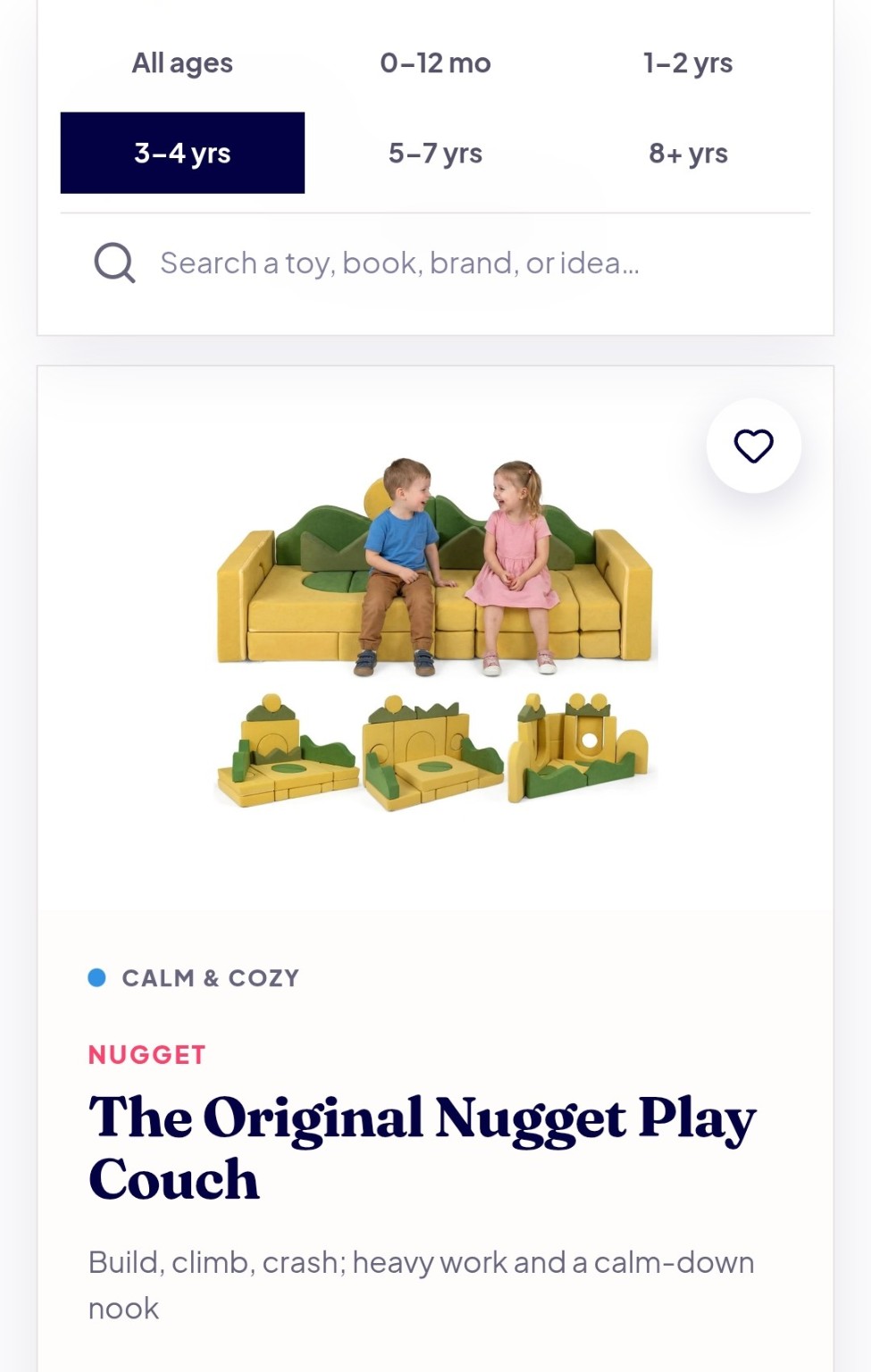
• No single “right” way to play. A Nugget play couch is a sofa, a fort, an obstacle course, and a reading nook. Play silks become capes, rivers, and picnic blankets.
• Room for new skills. Classic games like UNO start with matching colors and grow into strategy.
To keep interest going after the holidays:
• Rotate toys. Put half away and bring them back out in a few weeks so they feel new again.
• Change the setup. Move the blocks next to the toy cars, or the play dough next to the kitchen set.
4. How can families choose toys for siblings of different ages, especially when toddlers share space with older children’s toys?
My older boys might want to build something complicated while the three littles want to investigate every single piece. If you know, you know. Here’s what Jen suggested about keeping that mix safe and fun.
• Start with safety. Older kids’ sets often have small pieces (game tokens, mini figures, 3D pen parts). Give them a home that toddlers can’t reach. A lidded organizer like the Caboodles case on our 8+ list works well for
collections.
• Pick toys that work at every level. Open-ended toys bridge ages: a wagon with blocks, play silks, a Bilibo, or a play couch. A toddler and a 7-year-old play with them differently, but they can play together.
• Give the younger child a real job in group games. A toddler can roll the die, flip the card, or be the “banker.” Cooperative games like First Orchard and Hoot Owl Hoot! have everyone on the same team, so nobody loses to
a big sibling.
• Protect some solo time for the older child. Something like a Rail Cube set or a coding robot can be their focused, “big kid” activity while the younger one naps.
5. What should parents look for in toys intended for movement, sensory play, or quieter downtime? How can they tell whether their child enjoys that kind of play?
I love the idea of a toy helping a child settle down, but how can we tell what kind of play each kid actually needs?
What to look for:
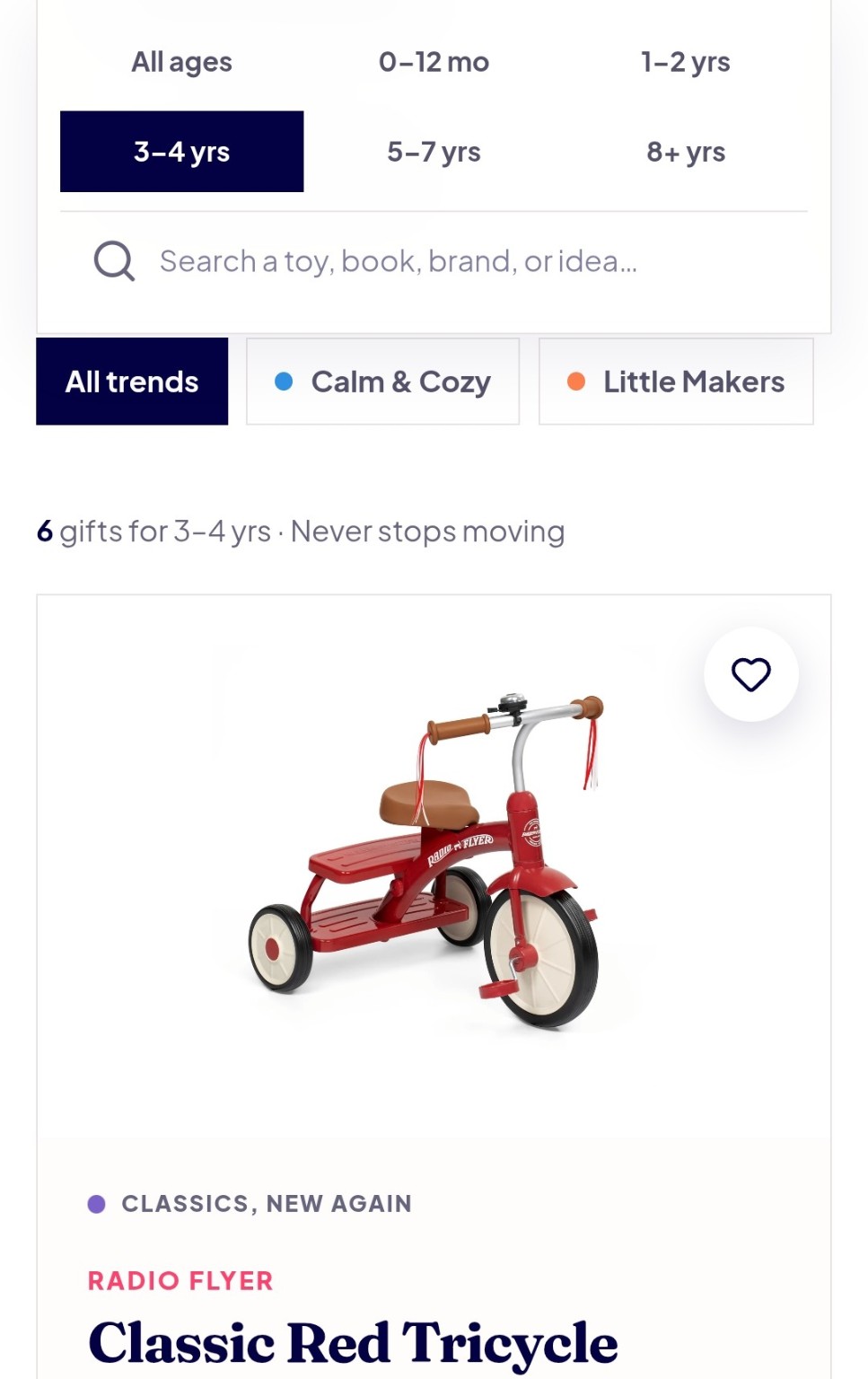
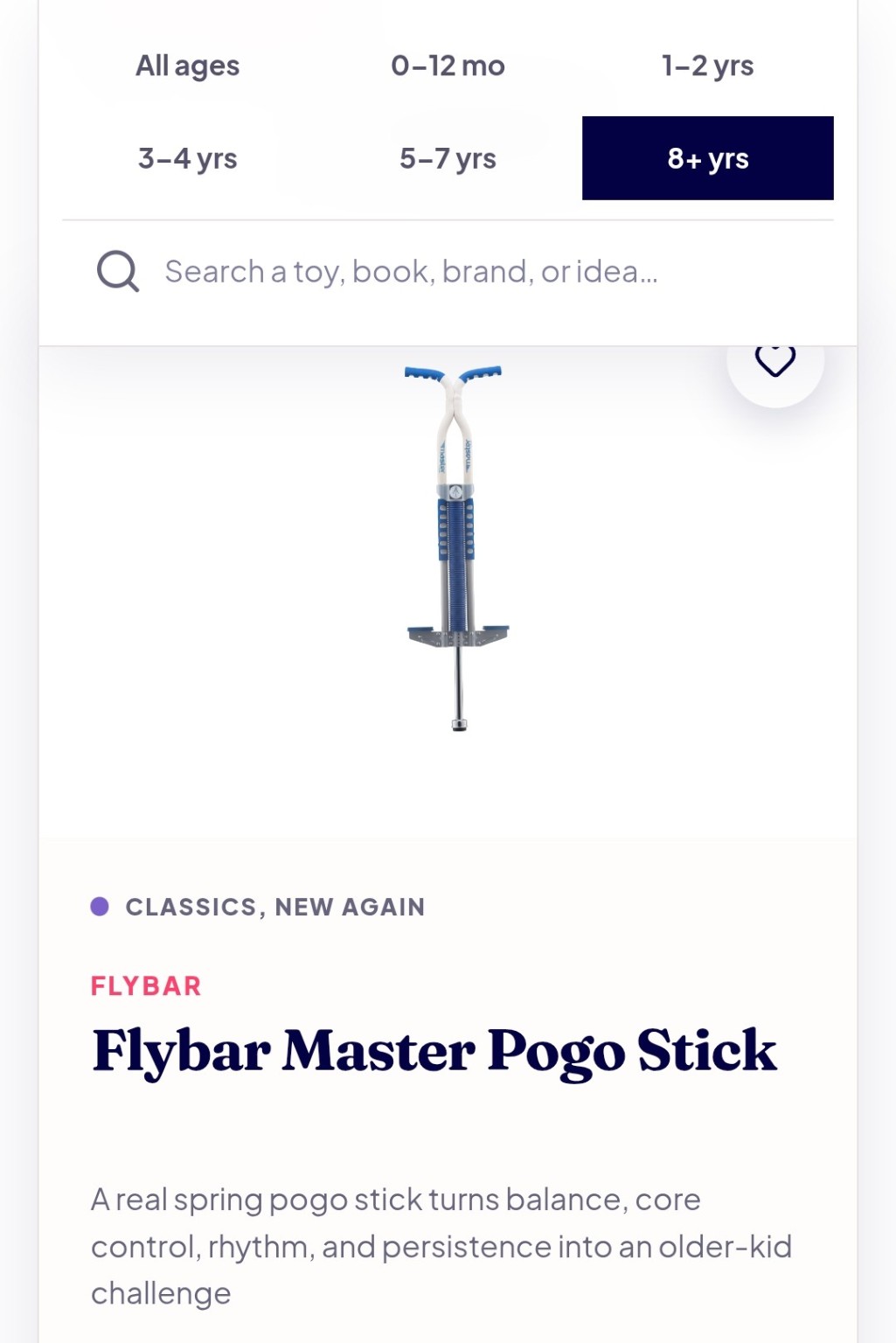
• Movement: Toys that get the whole body working and let kids take safe risks. Think a Bilibo for rocking and spinning, a classic tricycle, a Zoom Ball, or a pogo jumper for older kids.
• Sensory: Different textures, squeeze, and resistance. NeeDoh, Wigglitz, and Speks fidgets are good examples. Toys like these should calm a child, not wind them up more.
• Quiet downtime: Soft, weighted, or cozy things and books about feelings, like My Calm Down Book. Our therapists suggest a calm-down basket with one squeezable, one soft, and one heavy item, used
before hard moments, not only during them.
How to tell what your child gravitates toward:
• What do they seek out? Climbing furniture and crashing into cushions often means they want movement. Constantly touching things or chewing on sleeves may mean they want sensory input.
• Do they come back to it on their own? That’s the clearest sign.
• How do they seem afterward? Good play leaves a child more settled and focused. If a toy leaves them more frazzled, try something else.
6. What are some simple ways parents can join in without directing every moment or turning play into a lesson?
Sometimes we’re so busy trying to make everything educational that we forget we can just play with our kids. I asked Jen about that, too.
• Follow their lead. Sit nearby, copy what they’re doing, and let them decide where the play goes.
• Narrate, don’t quiz. Describe what you see (“You put the red one on top!”) rather than asking “What color is this?” Heather Katsahnias, Coral Care SLP, says: “Arts and crafts are a fun, low-pressure way to support your
child’s language development by modeling language naturally as you create together.”
• Say “tell me about it” instead of “what is it?” You’ll get a lot more language back.
• Wait before helping. When they get stuck, count to 10, then give a hint instead of fixing it. Isis Williams, Coral Care Occupational Therapist: “I always encourage parents to let their child explore and work through challenges
before stepping in to help.”
• Have fun yourself. Play the classic the way you used to. Kids learn a lot from watching a grown-up enjoy themselves.
7. For families on a tight budget, which versatile types of toys would you prioritize, and what can everyday household items offer?
And because I am absolutely not interested in pretending every family can spend a fortune on Christmas gifts, I asked which purchases matter most when money is tight.
If you’re only buying one or two things, prioritize:
• A good set of blocks or open-ended building pieces. They work from toddlerhood through elementary school.
• Art supplies. Washable paint, markers, a sketchbook. These build hand strength, control, and language.
• A classic card game. UNO and Spot It! are inexpensive and work on turn-taking, matching, and handling losing gracefully.
• Play silks or a few scarves. They’re cheap and endlessly useful for pretend play, peekaboo, and movement.
Household items our therapists use all the time:
• Cardboard boxes for forts, cars, and tunnels
• Pots, pans, and wooden spoons for cause-and-effect and rhythm
• Painter’s tape on the floor for balance lines and hopscotch
• Kitchen tongs and pom-poms or cotton balls for fine motor sorting
• Couch cushions for obstacle courses and crash pads
• A laundry basket to push, pull, and fill
8. How can books, including graphic novels, complement play and encourage creativity or conversations about friendship?
You knew I wasn’t getting through this interview without asking about BOOKS. And especially books that get kids thinking, talking, and creating.
• For babies and toddlers: Touch-and-feel books like
Ocean Friends build early language, because they give you and your child something to point at and name together.
• Books about feelings like My Calm Down Book give kids words for what’s happening in their bodies, which makes hard moments easier to talk about later.
• Books that spark curiosity, like Wanda Hears the Stars, show children someone who sees the world in their own way.
• Graphic novels are great for conversations about friendship because so much of the story lives in the characters’ faces and body language. Ask “How do you think she’s feeling? How can you tell?”
• Bring the book into play. Act out the story with toys, or have your child draw their own comic strip with markers and a sketchbook.
9. Could you choose three gifts from the guide, one for toddlers, one for preschoolers, and one for older children, and share a practical way to play with each?
Finally, I asked Jen to pick three actual examples from the holiday guide and explain what parents could do with each.
• Toddlers: Bilibo Midi. This simple shell is a rocker, a spinner, a bucket, and a hat.
Try this: Have your toddler sit inside and rock side to side while you sing a song, then stop when the song stops. It builds balance and core strength, and gives them practice taking turns and waiting.
• Preschoolers: Mini Farmstand Sorting Set.
Try this: Play “store.” Your child sorts the produce by color or type, then you come shopping and ask for “two red apples and one carrot.” They practice fine motor skills, counting, and back-and-forth conversation.
• Older kids: Rhino Hero. Players build a wobbly tower out of cards and move the rhino up floor by floor.
Try this: Before each turn, have your child say out loud where they’ll put the card and why. It works on steady hands, planning, and staying calm when the tower comes down.
My biggest takeaway: play doesn’t have to cost a fortune
Here’s what I keep coming back to: children need opportunities to explore, imagine, experiment, and connect with the people around them. That doesn’t mean every Christmas gift needs seventeen buttons, flashing lights, or an educational claim printed across the box.
It also doesn’t mean we have to turn every moment of play into a lesson. Sometimes a basket of blocks, a book, a stack of couch cushions, or a game together is plenty.
And with five kids, I particularly appreciate the reminder that it’s okay to protect the older kids’ more complicated activities while finding ways the littles can join in safely.
And speaking of keeping children entertained without another screen, I loved exploring screen-free crafts and creative family fun in my interview with Kim McLeod.
I’ll still be Christmas shopping. There will probably still be a mountain of wrapping paper. But maybe this year I’ll be a little more thoughtful about whether a toy can grow with the kids instead of becoming another archaeological discovery under my sofa in March.
And if anyone has discovered a way to keep five kids happily playing with the same activity for more than ten minutes, I’m accepting suggestions. Preferably before Christmas. 🤣❤️
And don’t put these ideas away after Christmas!
One thing I want to emphasize: just because Coral Care organized these recommendations into a holiday gift guide doesn’t mean they magically stop being useful when December is over. These are great ideas for birthdays, Easter baskets, special milestones, or even a rainy Tuesday when you want something fresh to do together.
With five kids, there is ALWAYS another birthday sneaking up on me. LOL. I’d much rather have a list of toys and activities that can keep growing with them than feel like I have to start my gift-shopping research from scratch every single time.
Explore the gift guide
Visit Coral Care’s 2026 Holiday Gift Guide for its complete recommendations, or learn more about its services at CoralCare.com.
Connect with Coral Care: Follow them on Instagram (@joincoralcare), Facebook, and LinkedIn for more play-based pediatric development tips, family resources, and updates.
Editor’s note: This interview was coordinated through Pitch PR. Jen Wirt’s biography and headshot were supplied by her public relations team, and Coral Care approved use of the “Play is how we Grow” brand graphic. Product images are shown from Coral Care’s gift guide. Products discussed are Coral Care’s recommendations; In My Mom Era did not receive review samples or independently test these items for this feature. Observe manufacturers’ safety warnings, especially around small parts and toddler access.
Enjoyed this interview? Subscribe to In My Mom Era for more real-life parenting, books, travel, interviews, and the occasional completely unnecessary rabbit hole. ❤️




Leave a Reply