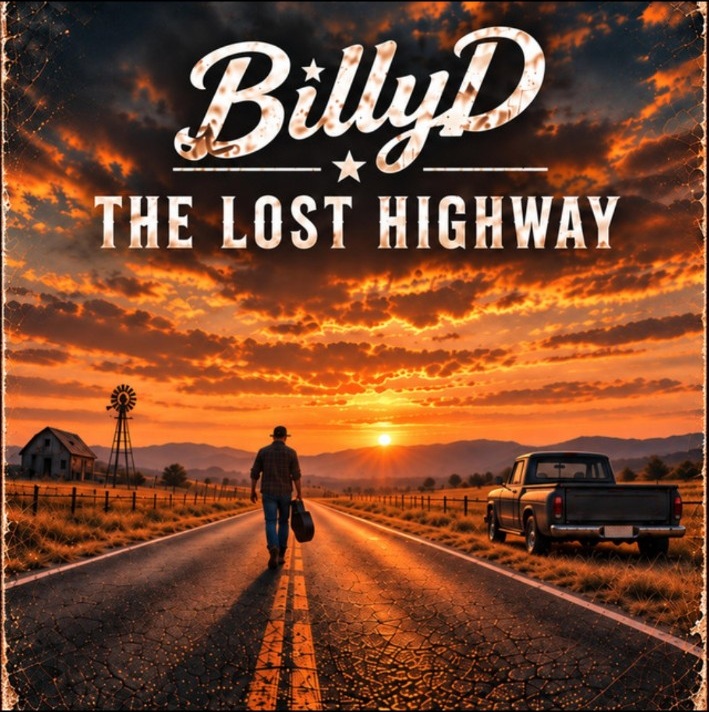
Exclusive interview and album review by Kelly Gegg | In My Mom Era
Some albums announce themselves with a big chorus. Others feel like someone pulling up a chair and saying, “Let me tell you where I’ve been.” BillyD’s The Lost Highway did both for me. After listening to all 14 tracks with my husband, Ty, I kept coming back to one thought: this record feels like one enormous “Listen up, this is me” anthem.
That impression became even more interesting when I interviewed the songwriter behind the project, Bill Daker. The stories behind these songs stretch from a guitar given to a six-year-old boy, to a bandmate’s voice preserved on a cassette for nearly three decades, to family motorcycle rides and a moment of silence among the California redwoods. They also raise a timely question about what it means to make music when the vocals and instruments on a finished album are generated with AI.
Disclosure: This is an independent editorial review and written interview. BillyD / Foundry 27 Records provided interview responses and approved promotional imagery for this feature. The opinions about the album are my own.
First, the listening test: two Missourians and 14 tracks
I love music that makes me feel something, and I love a good road trip even more. So an album called The Lost Highway was already speaking my language. What surprised me was how often I stopped to listen to an arrangement: the fiddle sound on “Lucky Man,” the opening of “Safest Path South,” and the haunting strings in “Disappear.” My personal standouts were “Lucky Man,” “Born for This,” “Safest Path South,” “That’s Who I Am,” and “Disappear.”
Then came the household plot twist: Ty, who generally isn’t enthusiastic about newer country music, enjoyed the album, too. He compared its sound to Brantley Gilbert’s earlier work. From him, that is a serious compliment. What I heard beneath the production was an ongoing conversation about identity, love, memory, struggle, and the freedom to keep moving.

The first guitar, the band, and the voice that stayed behind
Bill’s musical journey began when his father gave him a Sears Silvertone guitar and Johnny Cash’s “Folsom Prison Blues” record at age six. Later, he played in bands, including Charmed Life, alongside Ronnie and Bobby. Ronnie’s unexpected death brought that chapter to an end. Work and family took center stage, although Bill never entirely stopped writing.
One of the most affecting parts of our interview concerned Astral Plains, an album Charmed Life recorded mostly live at Chicago Trax in roughly two days. A rough cassette mix became the surviving master, and the recordings spent almost 30 years tucked away before being revisited.
“What struck me most when I finally revisited them were the memories of Ronnie and just how extraordinarily talented he was.”
Hearing those songs again also led Bill to reimagine the material as Songs From a Charmed Life, slowing arrangements down to give the lyrics more space. In his earlier days, he says, the guitar usually came first. Now a person, conversation, memory, or line of words sets a song in motion. That change—from music leading the story to the story leading the music—is at the heart of his return.
The important production detail: the album uses AI-generated performances
Here is something I did not know when Ty and I first listened: all of the recorded vocals and instrumentation on The Lost Highway were generated using Suno, according to Bill. That includes both voices on “Lucky Man,” as well as the fiddle and cello sounds I loved. It would be misleading to present those as performances by a studio fiddle player, cellist, or guest vocalist.
But that is not the same as saying Bill simply pressed a button and released whatever came out. He describes writing the stories and lyrics, setting the musical direction, developing arrangements, and making extensive creative choices about voices, emotion, phrasing, and production. He also uses his own guitar during the writing and refinement process. He says “That’s Who I Am” and “Disappear” began on guitar, and the chord progressions he wrote remain in the finished songs.
“The tool is available to millions of people. Taste isn’t. Ears aren’t. Judgment isn’t.”
For me, that transparency is part of what makes this interview worth having. You can appreciate a song, ask serious questions about AI and musicianship, and still want to understand the human choices behind it. Bill is not hiding the production method. He is explaining why it allows him to tell stories he might otherwise be unable to produce at this scale.
“Lucky Man”: gratitude found along the way
“Lucky Man” was already one of my favorites before I knew its inspiration. Bill says it grew out of a road-trip experience and the gratitude found in the small places and moments we sometimes overlook. He also wanted its sound to capture some of the atmosphere he loved in the television series Deadwood. The fiddle-like arrangement helps establish that feeling.
When I asked if I could embed a song for readers, Bill remembered that “Lucky Man” had stood out to me and offered it as one of his choices. Give it a listen as you read:
The songs that tell you who he is
I told Bill the album felt like a declaration of identity, even though he had not deliberately built a concept album. His response surprised me: he agreed that I had spotted a thread he had not fully recognized while making it. “That’s Who I Am” and “You Can’t Change Me” are deeply personal, he said, while other songs draw on people he has met and experiences he has witnessed.
“Safest Path South” is rooted in real motorcycle trips with his two brothers and his son, who leads their rides as Road Captain. They have covered thousands of miles together, sometimes trying to stay ahead of bad weather. Suddenly the road in that song felt even more vivid to me: it is not just a metaphor. It is family time measured in miles.
Bill has ridden more than 100,000 miles on motorcycles across the United States and Canada. He credits his wife, Sandie, with helping spark his love of travel; when they were younger and money was tight, driving was their way to see the world. As someone whose family considers a long drive a perfectly reasonable adventure, I understood that immediately.
It reminded me of another conversation I had for In My Mom Era, with songwriter Drew Ryder Smith about “Textile Town” and The Deep End. Drew drew inspiration from the remains of a South Carolina mill community and the family histories tied to places like it. I explored those same themes in my separate story about Drew Ryder Smith, Textile Town, and the people who came before us. BillyD’s roads and Drew’s abandoned town may look different, but both artists are asking us to notice the people, memories, and stories that might otherwise be lost along the way.
“Disappear” and “Silence of the Trees”: two different kinds of escape
“Disappear” struck me as one of the album’s most vulnerable songs. Bill wrote its lyrics as a teenager, when he spent his time playing guitar and felt misunderstood by people who thought he should be following a more conventional path. Decades later, a slower arrangement and cello sound allowed him to hear new emotional weight in words he had written so young.
“Silence of the Trees” came from a completely different moment. Bill and Sandie were traveling in a convertible Mini Cooper through Northern California, along the coast and into the redwoods. They stopped in a forested area and found themselves alone among the enormous trees, with sunlight filtering through the canopy. Bill described the silence and energy as life-changing. That memory eventually became a song.
I had asked whether the two tracks were emotionally connected. His answer revealed something better than a neat thematic plan: one came from the restless ache of youth, the other from the wonder of finding yourself exactly where you are.
The family song that gave The Lost Highway its name
Bill also offered a second song for this feature: the solo acoustic version of “Call Your Mama,” which closes the album. As a father of three, he wrote it to his son. Its message is simple and powerful: wherever life takes you, whatever happens, you can always call home. You are still welcome.
And here is the detail I absolutely love: “Call Your Mama” is the song from which Bill drew the album title. That makes this a beautiful companion to “Lucky Man.” One is about noticing what the road gives us. The other is about knowing where the road can always bring us back.
What comes next for BillyD?
Bill is not rushing toward another album or setting a release deadline. He would rather put out individual songs when they feel ready, letting a larger collection emerge naturally if it does. One newer song, “Someone Else’s Daughter,” was inspired by a painful encounter involving a woman in a small diner and the decline he sensed in the surrounding town.
He is also developing a series called The Writer’s Room, where he plans to sit with his guitar and explain the real people, places, and conversations behind his songs. As for a live concert, nothing is booked. Bill says he is rebuilding his playing skills and could imagine putting together a band someday, but he does not want to promise something before he is ready. Ty and I will keep our road-trip hopes alive.
My final take on The Lost Highway
I went into this album listening for the songs and came out thinking about the life behind them. My favorite arrangements sounded cinematic, the themes felt remarkably consistent, and the interview gave me a much deeper appreciation of why Bill chose to return to songwriting.
I also came away with a clearer understanding of what listeners are actually hearing. The Lost Highway is a songwriter-led project with AI-generated recorded performances, not a conventional band recording. That distinction matters. It also makes Bill’s willingness to talk openly about his process especially valuable.
If you enjoy country-flavored storytelling about family, identity, second chances, and roads worth taking, give the record a listen and decide what connects with you. My advice is to start with “Lucky Man,” stay for “Disappear,” and save a quiet moment for “Call Your Mama.”
Listen to the full album: The Lost Highway on Spotify
Visit the artist: BillyD Music
Interview responses provided by Bill Daker (BillyD) to In My Mom Era. Album artwork and promotional image courtesy of BillyD / Foundry 27 Records.
Special thanks to PR Newswire for Journalists for bringing BillyD’s The Lost Highway to my attention, and to Bill Daker and Foundry 27 Records for generously sharing the stories behind the music, answering my questions, and providing materials for this feature.



Leave a Reply